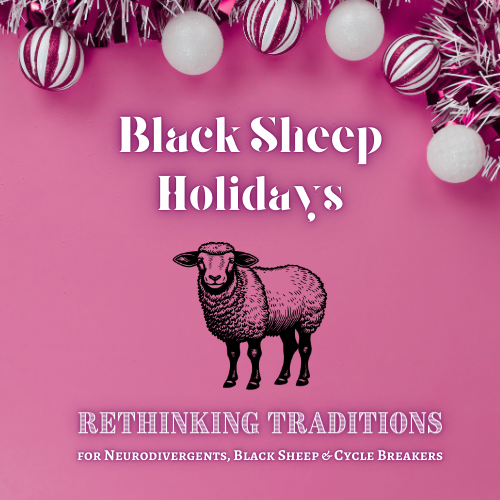
Black Sheep Holidays- Rethinking Tradition
Rethinking Tradition as a Black Sheep
Are you the black sheep of your family?
Congratulations—and condolences.
Some of us were seemingly cosmically assigned the role of cycle-breaker.
You get to be the last.
The last one in that toxic religion.
The last one to go undiagnosed.
The last to tolerate the abuse.
That’s a heavy weight to carry.
But—you also get to be the first.
The first to enjoy freedom.
The first to accommodate yourself.
The first to practice healthy communication with your partner and/or children.
Being the last in the cycle makes some things painfully clear:
You don’t fit. You never did—even when you were trying your hardest.
So guess what?
You get to let that shit go now.
If you’re going to chronically disappoint your family, you might as well do it with style.
Make it your own.
Create the holiday season you’ve always wanted—
whatever you celebrate, however you celebrate.
Tradition Is Great. Until It’s Not.
Traditions can be beautiful and anchoring.
They can create something bigger than the sum of their parts.
It’s not just the lights, the tree, or the stockings—it’s the vibe.
But traditions can also become breeding grounds for manipulation, boundary-crossing, stress, and self-denial.
If you were raised with toxic traditions—and if there’s a black sheep in the family, that’s likely—you know exactly what I mean.
One thing that tends to be consistent about black sheep is this:
we are deeply unwilling (or unable) to be inauthentic.
So when you’re expected to pretend that Uncle Larry using slurs against your gay cousin is somehow holiday magic, you’re not inclined to “keep the peace.”
You’ll be the one accused of ruining dinner—
even though Larry somehow gets off scot-free.
If a rule or tradition is bundled up with harm,
who is it actually for?
Now, you get to make the rules.
Rules that reflect the needs of you and your chosen family.
The Black Sheep Rules
Being the black sheep means you get to rewrite the whole thing.
One of the easiest ways to figure out what you want now
is to look closely at what didn’t work then.
Suffocating Structure
Maybe holidays in your family felt more like an obligation than a celebration.
All for appearances.
Dictated by a controlling parent.
If it felt like too much structure, here’s how adult-you can push back:
Kill Secret Santa.
Ditch rigid gift lists. Make, thrift, or buy gifts from the heart.
Skip dinner sign-ups and make it a free-wheeling potluck. Who cares if you end up with three desserts and no salad?
Stop hosting like a martyr. Appetizers count as dinner.
Trade rigid host/guest roles for facilitation and ease.
And let the formal Christmas cards go.
A short phone call, email, or text works.
Or nothing. Nothing is also fine.
Less to-do lists. Less performance. More presence.
Left in the Lurch Without a Plan
Maybe no one in your family took responsibility for the holidays at all—
leaving you stressed, disappointed, or forgotten.
If that’s you, structure can actually be supportive:
Make lists.
Share a calendar.
Assign roles.
Commit to hosting every year so you don’t have to rely on follow-through that never comes.
Go full fanfare: playlists, decor, advent calendars, cozy rituals.
Borrow traditions shamelessly—Christmas markets, community events, other people’s magic.
Less ambiguity and worry. More clarity and preparedness.
When the Debt-to-Joy Ratio Is Too High
If money stress ruined the holidays growing up, you don’t have to recreate that.
Swap big gifts for stocking stuffers.
Thrift. Reuse. Recycle wrapping paper. Trade. Make handmade gifts. Ignore trends.
Buy better versions of things you already need instead of novelty junk.
Potluck the meal—everyone shares the joy and the burden.
Skip the big trip. Or host, so others travel for once.
Spend less. Enjoy more.
“Cheapskate” Was the Vibe
Maybe your family treated holidays like an inconvenience—
and gifts came with guilt attached.
To change that narrative:
Let people express what they actually want ahead of time.
Apply a shared budget. It sounds counterintuitive, but it’s a set-it-and-forget-it solution.
Do Secret Santa with lists. One person. One budget. No one gets overlooked.
Keep gifting consistent between siblings. Clear expectations mean less comparison and resentment.
Set expectations. Get consistent results.
So Much Noise. So Many People.
Too many people? Too many obligations?
Stay for less time.
Stagger events.
Get a hotel so you can leave.
Choose intimacy over obligation.
Too few people?
Invite friends. Adopt a stray human or two.
Say yes to someone else’s table.
Volunteer. Build community on purpose.
Attend multiple gatherings with different groups.
Family isn’t limited to genetics. Holidays are for celebration—do what feels joyful.
Choose the Setting That Feels Like Relief
Too isolated?
Go somewhere festive—friends’, family’s, or a whole community of fellow celebrators.
Too chaotic?
Stay home. Make it quiet.
Split gift-opening into phases.
Protect slow mornings and early nights.
Too overwhelming?
Take breaks.
Create sensory-safe spaces.
Step outside. Sit in the backyard. Breathe.
Peace is a valid holiday destination.
Vibe Is Everything
Too formal?
Pajamas count.
Takeout counts.
Couch + movie = enough.
Let people come and go.
Not welcoming?
Don’t go.
Or don’t host.
Or have a very clear exit plan.
Emotionally limited or unsafe?
Add connection: games, questions, shared rituals.
Limit access to people who drain the room.
Boundaries are the tradition.
You set the tone.
And the tone is connection—not obligation.
Final Permission Slip
You were never meant to preserve traditions that erase you.
You were meant to design ones that fit your life, your body, your people.
If you’re going to be the odd one out anyway,
you might as well have fun with it.✨
Looking to relearn who you really are?
The Signature Soul workbook series helps you uncover what’s true, what’s yours, and what comes next—through guided reflection designed for clarity, self-trust, and realignment.